Scientific Concept
For more than 35 years, the European Space Agency (ESA) has been pioneering regenerative life-support technologies for long-duration space missions. At the centre of that effort is MELiSSA, the Micro-Ecological Life Support System Alternative: Europe’s leading programme for developing circular, closed-loop systems capable of sustaining human life in space.
MELiSSA exists to push the boundaries of autonomy on long missions, turning waste into what a crew actually needs to survive: food, water and oxygen. Its roots go back to 1987, when an early experiment flew aboard a Chinese Long March rocket. The conceptual framework followed in 1988, and formal programme activities began the year after (the full story is told under History).
What it is trying to achieve
MELiSSA’s objectives run from the purely scientific to the deliberately practical, but they all serve one overall strategy: build a closed-loop life support system that works, prove it rigorously, and put what is learned to use, in space and on Earth.
A regenerative system that continuously recycles water, air and waste into oxygen, clean water and food, enabling long-duration missions such as a crewed Mars habitat.
Mapping, quantifying and controlling the microbial, physico-chemical and plant-based processes involved, so they can be engineered with reliability and predictability.
Technologies and operational architectures that let a regenerative system run autonomously, with redundancy, minimal risk and high resilience in extreme environments.
Generating high-impact terrestrial applications: advanced water recycling, nutrient recovery, waste valorisation, controlled-environment agriculture and real-time environmental monitoring.
Uniting universities, research institutes, agencies and companies across Europe and beyond, to accelerate innovation in circular systems for both space and Earth.
Supporting long-term capacity building in life support, circularity and environmental systems through PhD programmes, operational pilots and interdisciplinary research.
ESA’s own overview of the MELiSSA project, its objectives and its innovation network is available on the ESA website.
ESA: the MELiSSA project ↗ Technical notes and publications →
Functional Ecology
Put simply, the objective of the MELiSSA Project is to develop a closed system, inspired by Earth’s own ecosystems, that reproduces their main functions with sharply reduced mass and volume, faster kinetics and, always, extreme safety margins. This approach is often called Functional Ecology, and it follows a structured, progressive method governed by what the project calls the ALiSSE criteria.
Mass
Energy
Efficiency
Safety
Crew Time
Today, thanks to the project, a large number of these recycling functions have already been demonstrated on the ground, at the MELiSSA Pilot Plant, and in space, through experiments such as ARTEMISS.
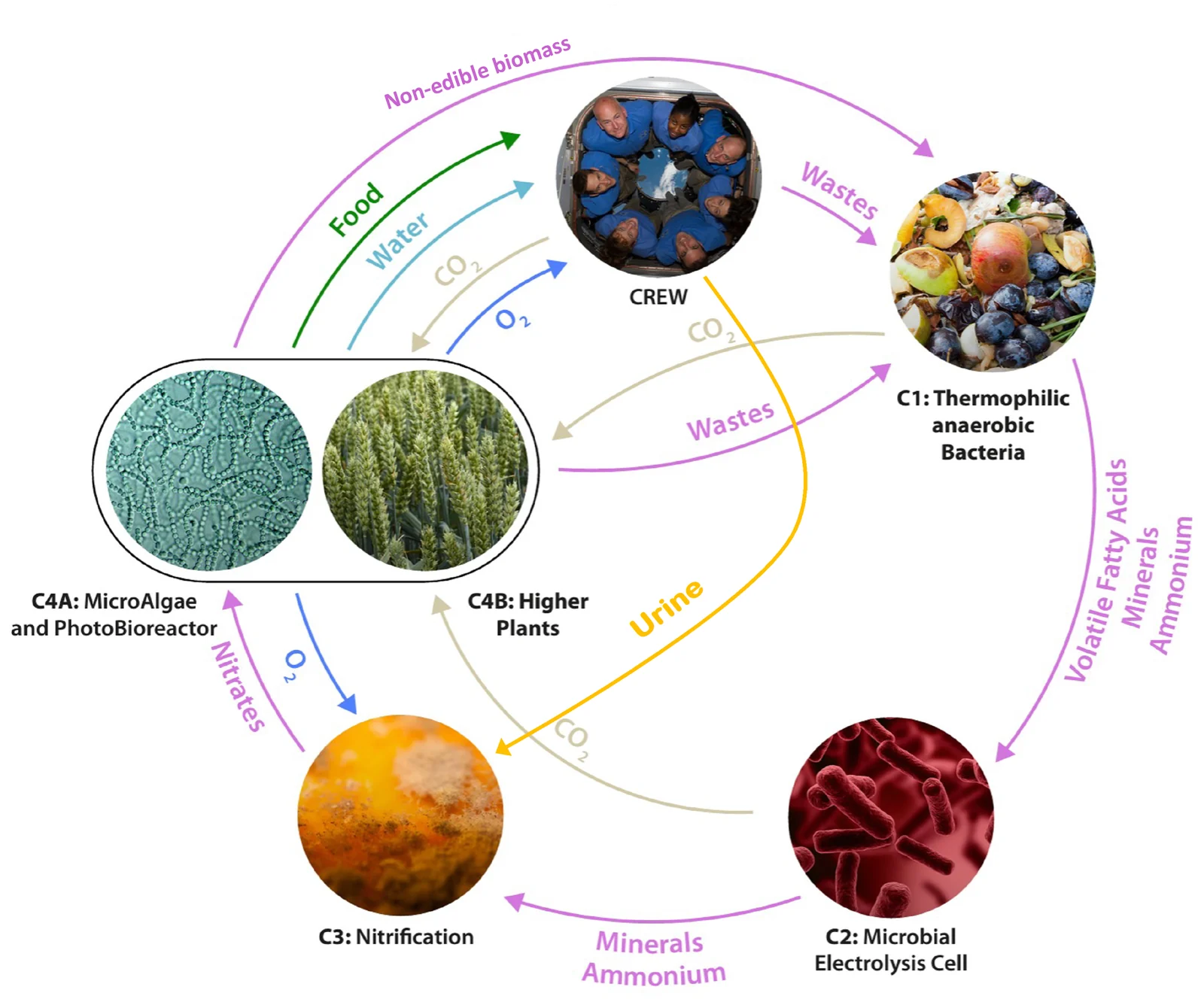
The five compartments
Technically, MELiSSA’s work is structured around five interconnected compartments that together form a closed loop, each studied on its own before being tested in integrated configurations that mimic a complete life support system for a future Mars habitat.
Processing and stabilising organic waste and wastewater from the crew.
Photo-heterotrophic microorganisms transforming waste products into useful compounds.
Nitrifying bacteria converting nitrogenous waste into plant-available nutrients.
Crops that produce oxygen and food while contributing to water purification.
Humans as the central consumers and producers of air, water, food and waste in the loop.
For engineering-level detail on each compartment, see the Research & Development pages.
What makes it hard
Designing a circular system demands a top-down view. Because every building block of the loop is connected to every other, no single block can be designed in isolation from its impact on the whole. The efficiency of each block matters enormously, but efficiency on its own is not sufficient: MELiSSA has to think metabolically, treating the loop as a single artificial ecosystem rather than a chain of separate recycling steps.
That challenge is not limited to efficiency. Reduced gravity and the wider space environment change how fluids behave, how microorganisms grow, and how plants develop, so processes that are well understood on Earth still have to be re-characterised for spaceflight before they can be trusted.